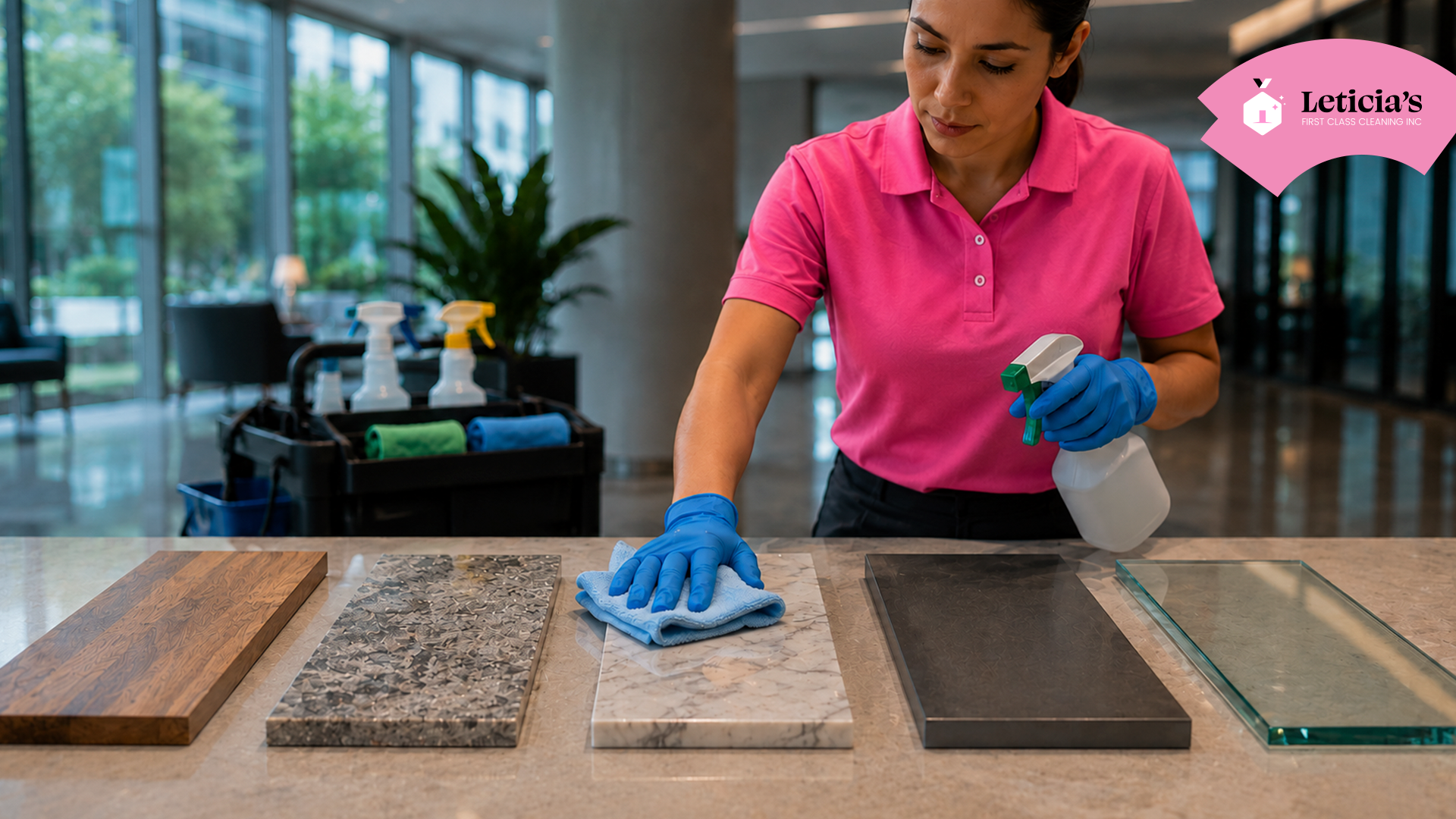
Nearly everyone has a favorite bottle.
It lives under the sink, at the front, where it can be reached without kneeling all the way down. It earned that position honestly, because it cut through something once, spectacularly, and ever since it has been the answer to every mess in the house. Kitchen counter. Bathroom sink. That thing on the coffee table. Whatever happened in the entryway.
It’s a reasonable habit. Most cleaning knowledge is built this way: something worked, so we generalize.
The trouble is that surfaces don’t generalize. They respond to chemistry, and they respond differently.
What a surface is actually reacting to
When a product meets a surface, a handful of variables decide what happens next:
Acidity and alkalinity. This is the big one. Acidic products are excellent at dissolving mineral deposits like the chalky ring in a kettle or the hard-water film on glass. But that same chemistry reacts with stone made of calcium carbonate. The Natural Stone Institute’s care and cleaning guidance explains it plainly: calcareous stones such as marble, limestone, travertine, and onyx are sensitive to acids, and mild, non-acidic cleaners are recommended instead. Vinegar and lemon juice belong in this category. The result on a polished marble vanity isn’t a stain that can be scrubbed away, but a dulled patch etched into the stone itself.
Abrasion. Scouring powders and rough pads work by physically removing a thin layer of whatever they touch. On an enamel sink, that may be tolerable. On a glossy finish, a stainless appliance, a glass cooktop, or sealed stone, it leaves fine scratches that catch light forever afterward.
Moisture and dwell time. Wood, especially unsealed or aged wood, doesn’t like standing water. A spray that sits for two minutes on a sealed granite counter is doing its job; the same two minutes on a hardwood floor seam is doing something else.
Finishes and sealants. Many surfaces aren’t really the material they appear to be, but the coating on top of that material. Sealed stone, finished wood, laminate, and coated cabinetry all depend on that layer staying intact. Harsh products don’t damage the substance underneath so much as strip what was protecting it.
Buildup. Using too much product is its own problem. Excess cleaner or soap that isn’t rinsed leaves a film, and film attracts soil, which is why an over-treated floor can look dull a day after it was cleaned. Rinsing is not an optional step.
Combinations worth reconsidering
A few pairings come up constantly in homes, and are worth a second look:
- Acidic cleaners, including vinegar and lemon, on marble, limestone, travertine, or onyx. Pick a pH-neutral cleaner made for stone.
- Abrasive powders or scouring pads on glossy or coated surfaces. Soft cloth, appropriate product, patience.
- A soaking-wet mop on hardwood. Damp, wrung out, and dried is the safer approach.
- All-purpose sprays on screens and electronics. These generally want a dry or barely damp microfiber cloth and nothing else.
- Mixing products in the hope of a stronger result. This one isn’t a finish issue but a safety issue. Cleaning products are formulated to be used as directed, and combining them can produce dangerous fumes. The American Cleaning Institute’s guidance on cleaning product safety is direct about never mixing products.
What professionals check before they choose
The habit that separates careful cleaning from confident cleaning is simply the order of operations. Before reaching for a product:
- Identify the material and, more importantly, the finish on top of it. Polished, honed, sealed, painted, laminated.
- Identify the soil. Grease, mineral deposit, protein, dust, and ink don’t respond to the same chemistry, and using a stronger product on the wrong kind of soil rarely helps.
- Read the label. It’s the least glamorous step and the most useful one. The ACI’s guide to how to read a product label breaks down what the directions, warnings, ingredients, and storage sections are actually telling you, including the surfaces a product is meant for.
- Test somewhere inconspicuous. Under the overhang, behind the door, in the corner of the closet.
- Consider the household. Children, pets, and people with sensitivities are part of the equation. For anyone wanting to narrow the field, the EPA’s Safer Choice program is a straightforward public resource for identifying products evaluated for their ingredients.
The quieter lesson
Matching products to surfaces isn’t really about buying more bottles. Most homes need fewer than they own: one neutral cleaner for most surfaces, one for glass, one appropriate for stone if there’s stone in the house, and something for the kitchen’s grease.
What it’s really about is a small shift in attention, the half-second it takes to ask what is this made of? before spraying. That half-second is the difference between a surface that ages well and one that quietly stops looking the way it did.
If you’d rather not have to think about it at all, that’s a fair preference too. You can request an estimate here and we’ll bring the right products for the surfaces you actually have.