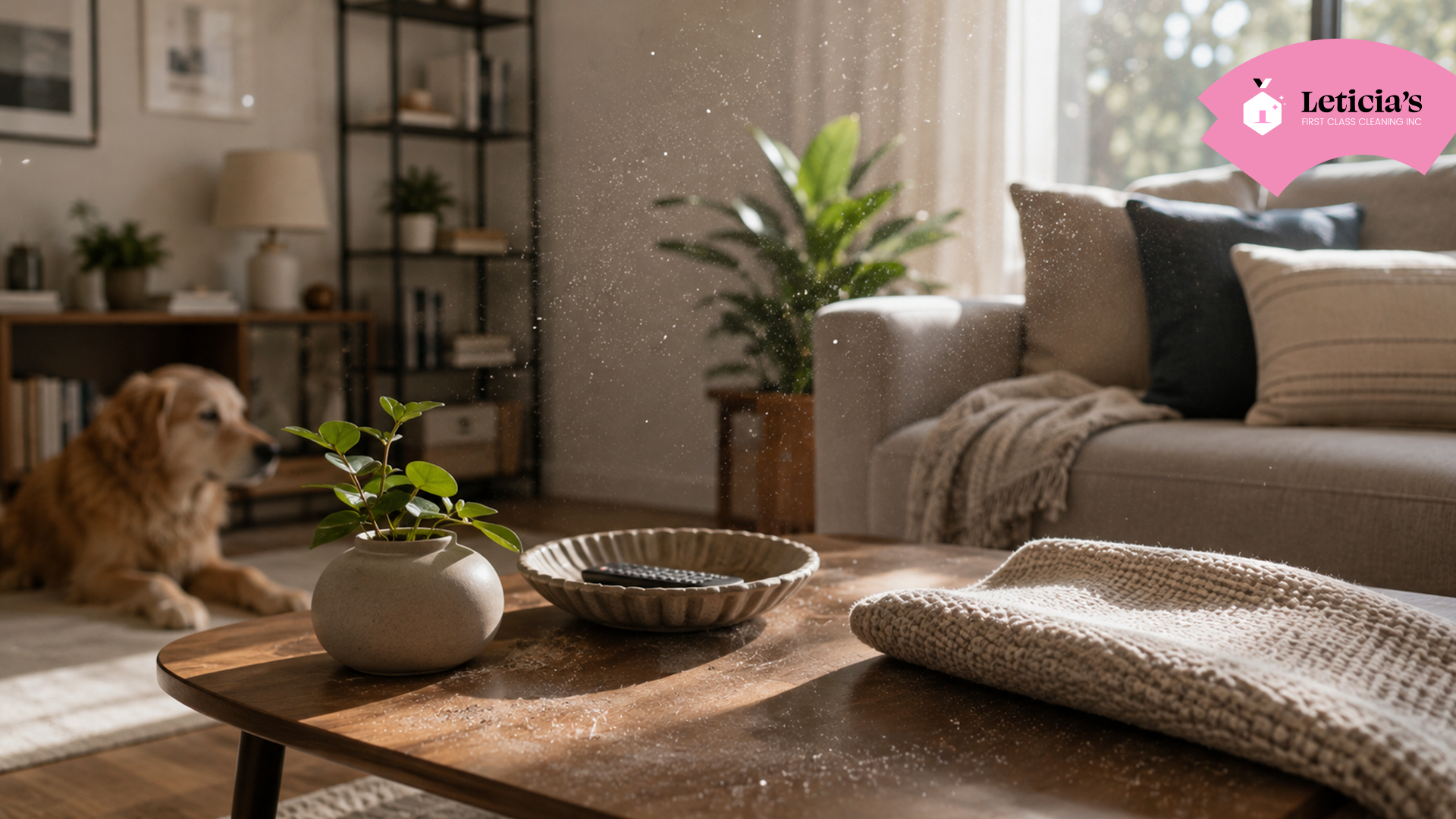
It usually happens on a Saturday morning, when the light comes through the window at a low angle and lands across the console table in the hallway.
You wiped that table. You know you did. It was Tuesday, with the good cloth, and it looked perfect afterward. And yet there it is again: a soft grey film, visible only from this exact angle, in this exact light, as if it had been waiting for you to sit down with your coffee.
Dust feels like a personal failing. It really isn’t. It’s just far more complicated than it looks.
Dust is not one thing
We talk about dust as though it were a single substance that arrives from a single place. It isn’t. It’s an accumulation, a mixture of whatever a particular home happens to produce and whatever happens to drift in from outside.
Some of it is generated indoors: fibers shed from rugs, upholstery, curtains, bedding, and clothing; skin cells; pet dander; paper fibers; particles from cooking. Some of it comes from outside and settles in: soil and road dust tracked in on shoes, pollen through open windows, particles that enter along with outdoor air. The EPA’s summary of sources of indoor particulate matter covers this territory well, since everyday activities, outdoor air and the materials in a home all contribute, and the mix shifts depending on how a household lives.
Which is why dust in a house with two dogs, a wool rug, and a wood-burning fireplace behaves differently from dust in a fourth-floor apartment with tile floors and closed windows. Same word, different phenomenon.
Two rooms, same house, different dust
Here’s the part that tends to surprise people: the bedroom and the living room in the same home can collect dust at noticeably different rates, and it isn’t random.
A few things drive the difference:
Textiles. Rooms with more soft material, such as rugs, curtains, upholstered furniture and bedding, both generate more fibers and hold more of what settles, releasing it again with movement.
Airflow. Air doesn’t move evenly through a home. Doorways, hallways, vents, and the paths between rooms create currents that carry particles toward some surfaces and away from others.
Distance from the door. The closer a space is to an entry, the more tracked-in soil it receives. Entryways are the busiest intersection in any house.
Static and elevation. Screens, plastics, and electronics attract fine particles; high shelves collect what stays airborne longest and settles slowest.
How the room is used. A room where clothes are changed, laundry is folded, or a bed is made every morning is a room where fibers are put back into the air daily.
That one shelf that always seems dusty again immediately is usually sitting at the intersection of two of these, perhaps near a doorway with a draft, at eye level, beside a lamp that’s warm and slightly static.
Why wiping sometimes makes it worse
There’s also a technique problem hiding inside the mystery.
A dry feather duster or a dry cloth on a hard surface often doesn’t remove dust so much as relocate it. The finest particles lift, drift, and settle again nearby, sometimes within the hour, which is exactly the sensation of dust “coming back overnight.”
What tends to work better is capture rather than displacement:
A slightly damp cloth, or a microfiber cloth used dry, holds particles instead of launching them.
Working from high surfaces downward means anything disturbed lands on a surface you haven’t cleaned yet.
Vacuuming textiles regularly, including rugs, upholstery and curtains, removes the reservoir rather than the symptom.
Washing bedding on a consistent rhythm reduces one of the most productive fiber sources in the house.
Mats at the entrance, and shoes off inside, cut down on the soil that becomes tomorrow’s dust.
Filtration matters, too. If a home has a central system, maintaining the filter is part of dust control, and the EPA’s guide to air cleaners in the home is a useful, non-commercial place to understand what filtration can and can’t do.
A gentler way to think about it
Dust returning isn’t evidence that the cleaning didn’t work. It’s evidence that the house is occupied, that people came home, opened a window, cooked dinner, sat on the sofa, and slept in the bed.
The goal was never a dust-free house. The goal is a home where dust is managed steadily enough that it never becomes something you have to think about on a Saturday morning.
If keeping up with that rhythm has started to feel like more than it should be, that’s a reasonable place to ask for help. You can request an estimate here and we’ll build a routine around how your home is actually lived in.
It lives under the sink, at the front, where it can be reached without kneeling all the way down. It earned that position honestly, because it cut through something once, spectacularly, and ever since it has been the answer to every mess in the house. Kitchen counter. Bathroom sink. That thing on the coffee table. Whatever happened in the entryway.
It’s a reasonable habit. Most cleaning knowledge is built this way: something worked, so we generalize.
The trouble is that surfaces don’t generalize. They respond to chemistry, and they respond differently.
What a surface is actually reacting to
When a product meets a surface, a handful of variables decide what happens next:
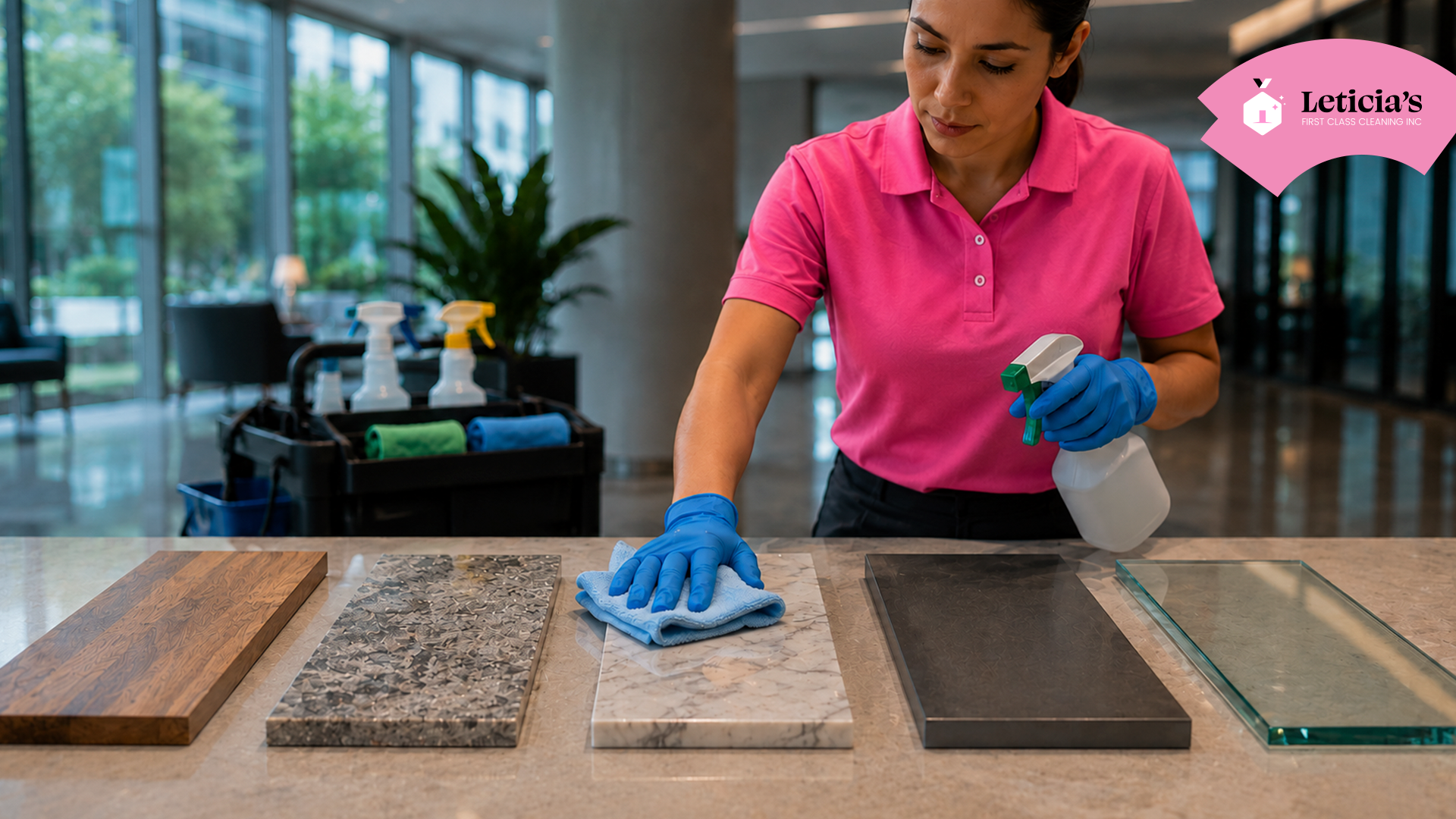
Acidity and alkalinity. This is the big one. Acidic products are excellent at dissolving mineral deposits like the chalky ring in a kettle or the hard-water film on glass. But that same chemistry reacts with stone made of calcium carbonate. The Natural Stone Institute’s care and cleaning guidance explains it plainly: calcareous stones such as marble, limestone, travertine, and onyx are sensitive to acids, and mild, non-acidic cleaners are recommended instead. Vinegar and lemon juice belong in this category. The result on a polished marble vanity isn’t a stain that can be scrubbed away, but a dulled patch etched into the stone itself.
Abrasion. Scouring powders and rough pads work by physically removing a thin layer of whatever they touch. On an enamel sink, that may be tolerable. On a glossy finish, a stainless appliance, a glass cooktop, or sealed stone, it leaves fine scratches that catch light forever afterward.
Moisture and dwell time. Wood, especially unsealed or aged wood, doesn’t like standing water. A spray that sits for two minutes on a sealed granite counter is doing its job; the same two minutes on a hardwood floor seam is doing something else.
Finishes and sealants. Many surfaces aren’t really the material they appear to be, but the coating on top of that material. Sealed stone, finished wood, laminate, and coated cabinetry all depend on that layer staying intact. Harsh products don’t damage the substance underneath so much as strip what was protecting it.
Buildup. Using too much product is its own problem. Excess cleaner or soap that isn’t rinsed leaves a film, and film attracts soil, which is why an over-treated floor can look dull a day after it was cleaned. Rinsing is not an optional step.
Combinations worth reconsidering
A few pairings come up constantly in homes, and are worth a second look:
Acidic cleaners, including vinegar and lemon, on marble, limestone, travertine, or onyx. Pick a pH-neutral cleaner made for stone.
Abrasive powders or scouring pads on glossy or coated surfaces. Soft cloth, appropriate product, patience.
A soaking-wet mop on hardwood. Damp, wrung out, and dried is the safer approach.
All-purpose sprays on screens and electronics. These generally want a dry or barely damp microfiber cloth and nothing else.
Mixing products in the hope of a stronger result. This one isn’t a finish issue but a safety issue. Cleaning products are formulated to be used as directed, and combining them can produce dangerous fumes. The American Cleaning Institute’s guidance on cleaning product safety is direct about never mixing products.
What professionals check before they choose
The habit that separates careful cleaning from confident cleaning is simply the order of operations. Before reaching for a product:
Identify the material and, more importantly, the finish on top of it. Polished, honed, sealed, painted, laminated.
Identify the soil. Grease, mineral deposit, protein, dust, and ink don’t respond to the same chemistry, and using a stronger product on the wrong kind of soil rarely helps.
Read the label. It’s the least glamorous step and the most useful one. The ACI’s guide to how to read a product label breaks down what the directions, warnings, ingredients, and storage sections are actually telling you, including the surfaces a product is meant for.
Test somewhere inconspicuous. Under the overhang, behind the door, in the corner of the closet.
Consider the household. Children, pets, and people with sensitivities are part of the equation. For anyone wanting to narrow the field, the EPA’s Safer Choice program is a straightforward public resource for identifying products evaluated for their ingredients.
The quieter lesson
Matching products to surfaces isn’t really about buying more bottles. Most homes need fewer than they own: one neutral cleaner for most surfaces, one for glass, one appropriate for stone if there’s stone in the house, and something for the kitchen’s grease.
What it’s really about is a small shift in attention, the half-second it takes to ask what is this made of? before spraying. That half-second is the difference between a surface that ages well and one that quietly stops looking the way it did.
If you’d rather not have to think about it at all, that’s a fair preference too. You can request an estimate here and we’ll bring the right products for the surfaces you actually have.
Whenever people tell me they’re expecting guests, they usually say the same thing:
“I need to clean the whole house.”
I always smile because, in reality, most guests aren’t walking through your home looking for flaws. They’re there to spend time with you, celebrate, or simply enjoy being together.
Still, there are a few places that almost everyone notices within the first few minutes of arriving. These small details quietly shape how welcoming and comfortable a home feels.
Here are the five areas that tend to make the biggest first impression.
The front entrance
Your entryway sets the tone before anyone even steps inside.
A clean porch, a tidy walkway, and a welcoming front door immediately make visitors feel cared for. It doesn’t need to be elaborate—it simply needs to feel inviting.
The floors
People may not consciously inspect your floors, but they certainly notice when they’re dusty, sticky, or covered with pet hair.
Since guests naturally move through living rooms, kitchens, and hallways, clean floors help the entire home feel fresher.
The guest bathroom
If there’s one room worth a few extra minutes of attention, this is it.
Fresh towels, a clean mirror, spotless fixtures, and a well-stocked soap dispenser go a long way toward making guests feel comfortable.
It’s often one of the smallest rooms in the house, but one of the most memorable.
The kitchen
Whether you’re serving a full meal or simply offering drinks, people naturally gather in the kitchen.
Clean countertops, organized spaces, and clutter-free surfaces help create a relaxed atmosphere where everyone feels welcome.
The little details
Sometimes it isn’t about one specific room at all.
Fingerprints on glass doors, dusty shelves, overflowing trash bins, or unpleasant odors are the small things people notice without realizing it. Individually they may seem insignificant, but together they influence how comfortable a home feels.
“A welcoming home isn’t the one that’s perfectly clean. It’s the one where guests immediately feel comfortable.”
Hosting should be about making memories
Summer is full of birthdays, barbecues, family visits, and spontaneous get-togethers.
Preparing your home shouldn’t become another source of stress. Taking care of a few high-impact areas can make a much bigger difference than trying to make every room look perfect.
And when life gets especially busy, having a little extra help can mean spending less time cleaning and more time enjoying the people who came to see you.
If you’re preparing your home for guests this season, we’re here to help. Contact us to learn how our residential cleaning services can keep your home fresh, welcoming, and ready for every gathering.
Summer has a way of bringing people together. Family members stop by more often, friends gather for cookouts and celebrations, and many households find themselves opening their doors to visitors they haven’t seen in months.
When that happens, most homeowners immediately start thinking about cleaning. Not because they want a perfect house, but because they want people to feel comfortable when they walk through the door.
The truth is, guests rarely remember whether every surface was spotless or every cushion perfectly arranged. What they remember is how the home felt. Was it welcoming? Comfortable? Relaxed? A clean and organized space helps create that feeling long before the first conversation begins.
The spaces people notice without realizing it
Before guests settle into the living room or gather around a dining table, they quietly take in their surroundings. Entryways create first impressions. Kitchens naturally become gathering places. Bathrooms are often judged more closely than homeowners realize. Windows influence how bright and inviting a space feels throughout the day.
These areas don’t need to be flawless, but they do benefit from extra attention before a busy hosting season begins.
One advantage of preparing early is that cleaning becomes far less stressful. Instead of rushing through chores the day before guests arrive, homeowners can focus on enjoying the occasion itself. A little preparation often creates a much more relaxed experience for everyone involved.
“People may not remember every detail of your home, but they will remember how comfortable they felt inside it.”
Don’t forget about your own summer plans
Interestingly, preparing a home for summer isn’t only about receiving visitors.
For many families, summer is also vacation season. Travel plans are made, bags are packed, and attention shifts toward flights, road trips, and itineraries. Yet one of the best feelings after returning home is walking into a clean and organized space.
Anyone who has come back from a wonderful vacation to overflowing laundry baskets, dirty dishes, or unfinished chores understands the difference immediately. The transition back to everyday life feels easier when home already feels refreshed and cared for.
That is why many homeowners schedule a thorough cleaning before leaving town. It allows them to focus on enjoying their trip while knowing that returning home won’t mean starting the week with a long list of tasks.
For families looking for additional support before a trip, residential cleaning services can help prepare the home for both departure and return.
Summer rentals deserve the same attention
For property owners who host guests through vacation rentals, summer brings a different kind of opportunity—and responsibility.
Guests form opinions quickly. Cleanliness influences comfort, reviews, repeat bookings, and overall satisfaction. A beautifully decorated property can still leave a poor impression if cleaning standards are inconsistent between stays.
Preparing a vacation rental goes beyond changing linens or restocking supplies. It involves creating an environment that feels fresh, cared for, and ready for the next arrival. Consistency is often what separates an average guest experience from a memorable one.
That is why many property owners rely on professional vacation rental cleaning services to help maintain the standards guests expect throughout the busiest months of the year.
Get ready for the season ahead
Whether you’re preparing for family visits, hosting summer gatherings, managing a vacation rental, or planning a trip of your own, a clean home helps every experience start on the right foot.
Summer already brings enough activity to keep families busy. Cleaning shouldn’t be the reason you feel overwhelmed.
If you’d like help preparing your home for the season ahead, request a free cleaning estimate and discover how professional cleaning support can help you spend less time worrying about chores and more time enjoying what summer is meant for.
Every summer, I hear some version of the same question from homeowners:
“Why does my house seem to get dusty so much faster this time of year?”
The short answer is simple: it probably does.
If your floors seem harder to keep clean, if dust reappears a day or two after cleaning, or if you’re wondering whether your family suddenly became experts at tracking dirt through the house, you’re not imagining things. Summer changes the way most homes are used, and that naturally affects how quickly dust and debris accumulate.
Many people assume they’re falling behind on housekeeping when this happens. In reality, seasonal conditions often play a bigger role than they realize.
Summer brings more dust than most people expect
One reason homes become dustier during summer is that people tend to spend more time moving between indoor and outdoor spaces. Children are home from school, pets spend more time outside, guests visit more frequently, and doors are often opened throughout the day.
At the same time, summer weather introduces its own challenges. Wind carries dust and pollen, dry conditions allow particles to travel more easily, and air conditioning systems continuously circulate air throughout the home. Even when windows remain closed, dust can still find its way indoors through normal daily activity.
This combination of increased traffic and seasonal conditions explains why many homeowners feel like they’re cleaning more often but seeing fewer lasting results.
Why a clean home matters more than appearance
Most parents and homeowners don’t care about cleanliness because they expect perfection. They care because the condition of a home directly affects comfort, health, and peace of mind.
A clean environment helps reduce allergens, improves overall comfort, and creates a space where family members can relax and spend time together without feeling overwhelmed by clutter or constant chores. For many households, keeping a home clean is simply another way of caring for the people who live there.
That is why seasonal increases in dust can feel frustrating. It isn’t necessarily about the dust itself. It’s about the extra time and energy required to stay on top of it while balancing work, family responsibilities, and everything else that fills a busy schedule.
“A busy home isn’t a sign of failure. Most of the time, it’s a sign that life is happening.”
Keeping up without feeling overwhelmed
The good news is that summer dust doesn’t mean you’re doing something wrong. In most cases, it simply means your home is experiencing a busier season.
Small habits such as changing HVAC filters regularly, keeping entryways clean, vacuuming high-traffic areas more frequently, and wiping down surfaces before dust accumulates can help reduce the impact. Still, many families find that maintaining the same level of cleanliness requires additional support during the busiest months of the year.
That is one reason homeowners often turn to professional residential cleaning services during summer. Consistent cleaning helps control dust buildup, keeps living spaces comfortable, and allows families to spend less time cleaning and more time enjoying the season.
Enjoy summer without constantly chasing dust
Summer should be spent making memories, enjoying longer days, and spending time with the people who matter most—not constantly wondering why the floors need attention again.
If keeping up with dust, dirt, and daily household activity feels harder than usual this season, you’re not alone. Request a free cleaning estimate and discover how professional cleaning support can help keep your home fresh, comfortable, and ready for whatever summer brings.
It’s not just about who cleans… it’s how it gets done
Most people feel they should be able to handle cleaning on their own.
And in many ways, they do. You organize, wipe down surfaces, take care of what’s visible… and for a moment, everything feels in place.
But a home doesn’t stay still.
Life keeps moving. People come and go, meals are made, days get busy. And little by little, things begin to build up again — not always in obvious ways, but in the details that are easy to overlook.
What we see VS What stays behind
DIY cleaning usually focuses on what’s right in front of us — what looks out of place, what feels urgent.
But there’s another layer that doesn’t always get the same attention.
Dust settling in less visible areas
Buildup on frequently touched surfaces
Residue that doesn’t fully go away
Spaces that are skipped because there’s no time
It’s not about doing it wrong. It’s about how much can realistically be done in the middle of everything else, especially when most routines rely on DIY approaches.
Where professional cleaning makes a difference
Professional cleaning isn’t just about doing more — it’s about following a structured approach like residential cleaning services.
It’s about doing it with structure, consistency, and intention. It follows a process. It reaches spaces that are often missed. And more importantly, it keeps the home from slowly slipping out of balance.
That’s why many families don’t see it as a replacement for what they do — but as support that helps everything stay under control.
A different way to look at it
“ It’s not about choosing between doing it yourself or getting help… it’s about deciding how you want your home to feel every day. ”
When cleaning becomes something you’re always catching up with, it starts to feel heavy. But when there’s a system behind it, the home simply works better.
Finding the balance that works for you
Every home is different, and there’s no single right way to take care of it.
But there is a difference between constantly reacting… and having a space that stays consistently cared for.
If you’ve ever felt like your home is always one step behind, it might be time to explore a more balanced approach — one that supports your routine instead of competing with it.
There’s a point when your home stops feeling like a place to rest, and starts feeling like something you need to manage.
It doesn’t happen overnight. It builds gradually — a few things out of place, spaces that don’t fully reset, routines that get harder to keep up with. Over time, what used to feel normal begins to feel heavy.
And that’s when your home starts working against you instead of supporting you.
When Your Space Adds to Your Stress
A home doesn’t need to be “messy” to feel overwhelming.
Sometimes it’s just inconsistent.
A kitchen that’s never quite done.
A room that’s always halfway organized.
Surfaces that slowly collect more than they should.
These small details create something bigger: mental noise.
Instead of helping you disconnect, your home becomes a constant reminder of what’s pending. And that low-level stress follows you throughout the day.
Why This Happens(Even If You’re Doing Your Best)
Most people assume the solution is simple: “I just need to be more organized.”
But daily life doesn’t always allow for that.
Between work, family, and responsibilities, maintaining a home at a consistent level takes more time and energy than most people realistically have. The issue isn’t lack of effort — it’s trying to handle everything without support.
And that’s where the cycle begins: things accumulate, energy drops, and the space starts to feel harder to manage.
What Actually Makes a Difference
The goal isn’t perfection. It’s stability.
When a home is maintained consistently, it changes how it feels to live in it. Spaces don’t get the chance to become overwhelming, and routines feel easier to sustain.
That’s why many families rely on ongoing support through residential cleaning services — not just to clean occasionally, but to keep their home functioning day to day.
A maintained home feels:
Lighter
More predictable
Easier to enjoy
And that shift is more impactful than most people expect.
A Home That Works for You
Your home should give you peace, not pressure.
If it’s starting to feel like “too much,” it’s not a failure — it’s a sign that something needs to change in how the space is being maintained.
You can start by understanding what level of support fits your lifestyle through a personalized cleaning estimate
A calm home isn’t about doing everything perfectly. It’s about creating a space that supports you… every day.
Spring cleaning sounds simple: open the windows, light a candle, wipe a few surfaces.
But most homes don’t need a refresh.
“They need a reset.
After months of closed windows, indoor heating, daily routines, and clutter, your home holds more than dust. It holds buildup in corners, fabrics, vents, and under furniture.
And that buildup doesn’t just affect how your home looks. It affects how your home feels.
Why Spring Cleaning Feels So Emotional
There’s a reason people feel lighter after cleaning.
A deep reset removes:
Hidden dust and allergens
Lingering odors trapped in upholstery
Kitchen grease buildup
Bathroom mineral residue
Window film that blocks natural light
When light comes back in, mood shifts. When air flows freely, energy changes.
Spring is not about aesthetics.
It’s about restoration.
The Areas Most Homes Forget
Over the years, I’ve noticed something.
Most families clean what they see — and skip what quietly collects.
Baseboards.
Ceiling fans.
Behind appliances.
Under sofas.
Window tracks.
Inside cabinets.
A proper spring reset goes beyond surface shine. It protects your home’s materials and keeps small issues from becoming bigger repairs.
If your home hasn’t had a structured deep cleaning in a while, professional residential cleaning services can help restore balance without overwhelming your schedule.
Light Changes Everything
One of the most underestimated parts of spring cleaning?
“Windows.
Dust and film buildup reduce natural light more than most homeowners realize. Proper window cleaning doesn’t just improve visibility — it transforms the atmosphere of a space.
More light, more clarity, more calm.
A Reset Is Different From Maintenance
Weekly cleaning maintains order.
A seasonal reset restores the foundation.
If you’re unsure what your home truly needs, browsing practical seasonal tips inside our cleaning guides and resources can help you identify where attention is overdue.
And if time is limited — because life is busy — requesting a professional home cleaning estimate allows you to approach the season with clarity instead of stress.
Spring only comes once a year.
But the feeling of walking into a home that truly feels fresh?
The end of the year always seems to sneak up on us.
Suddenly the calendar is full, the house feels busy, and we start wondering how another twelve months went by so quickly. Between celebrations, work, and planning for what’s next, our spaces often mirror our minds — a little cluttered, a little tired, and ready for a fresh start.
For me, that’s when cleaning becomes more than a routine. It turns into a quiet reset — a moment to slow down, breathe, and prepare the home (and heart) for a new chapter.
The Power of a Fresh Space
I’ve always believed that when a home feels clean, everything else feels possible. A polished table invites conversation. A cleared counter gives space to think. Even a streak-free window can shift your mood, letting in more light and perspective.
That’s why year-end cleaning isn’t just about tidiness; it’s about renewal. It’s a small act of self-care that clears away what’s been heavy. For some families, this means organizing closets and letting go of unused things. For others, it’s finally tackling that deep clean after a remodel — what our Construction Clean-Up team calls “the final polish before peace.”
Whatever it looks like for you, the message is the same: make room for what matters most.
Cleaning as Mindfulness
When you pick up, wipe down, and reorganize, you’re not only arranging objects — you’re quieting thoughts.
Try turning these moments into rituals. Open a window while you tidy the kitchen. Let music guide your pace. Notice the difference between chaos and calm.
And don’t forget to look up — literally. Clear glass always changes how a room feels. Our Window Cleaning services were inspired by that very idea: clarity you can see, and feel.
If you enjoy learning little ways to keep harmony at home, explore our Resource Base. It’s filled with simple, caring tips written for real families, not perfect ones.
Beginning Anew
As December winds down, I like to light a candle, pour a cup of tea, and walk through each room slowly.
It’s not inspection — it’s reflection. Each clean space becomes a reminder of what the year gave and what it taught.
A clean home at year’s end isn’t about perfection; it’s about peace. It’s the promise of stepping into January with less noise, more gratitude, and a heart ready for new beginnings.
Here’s to clear homes, clear minds, and the calm that follows a deep breath.